Extreme heat is a public health threat that lands hardest on the people precision wellness is meant to serve – and a Twin Cities campaign shows what culturally grounded prevention looks like in practice.
A Familiar Problem, A New Kind of Response
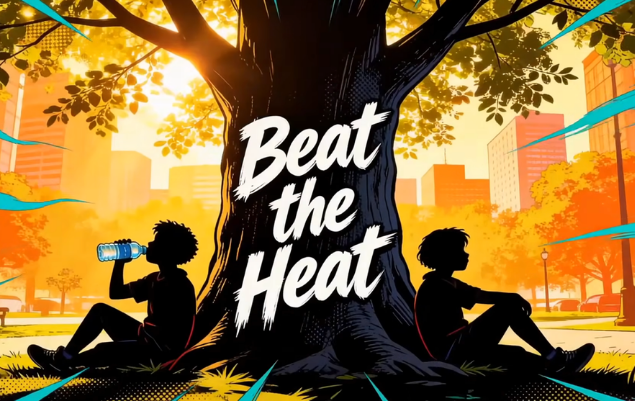
Minnesota summers are getting hotter, and more frequent extreme heat days have become a genuine public health concern-particularly for older adults, young children, people managing chronic conditions, outdoor workers, and anyone without reliable access to cooling. In response, Asian Media Access (AMA) partnered with Oromo Diaspora Media, the Islamic Civic Society of America, and Somali TV to launch “Beat the Heat: Extreme Heat Safety Video Series,” working with extreme heat experts at Hennepin County to translate public health guidance into short, animated videos produced in English, Spanish, Hmong, Oromo, and Somali.
The campaign is a useful model for the Center for Wellness Technology (CWT) to study closely. CWT’s programming at 19 Exchange St E is built around the same core premise that made AMA’s campaign work: health information only changes behavior when it reaches people in a language, format, and voice they already trust. That is precisely the gap CWT is positioned to close for downtown St. Paul’s wellness district-connecting point-of-care wellness, community health navigation, and the multicultural coalition model already anchoring the St. Paul Wellness Coalition.
How the Videos Were Built
Before producing a single frame, AMA ran community focus groups with youth, professionals, and older residents to test video style, pacing, messaging, and cultural relevance. The consistent feedback: keep it short, make it visual, and don’t make comprehension dependent on hearing the narration in English. That input shaped the final format-an animated storytelling approach starring Minnesota’s state flower, the Lady Slipper Orchid, as a friendly, memorable guide that reads across age groups without needing translation to land emotionally. The English, Spanish, and Hmong videos AMA produced can be viewed here.
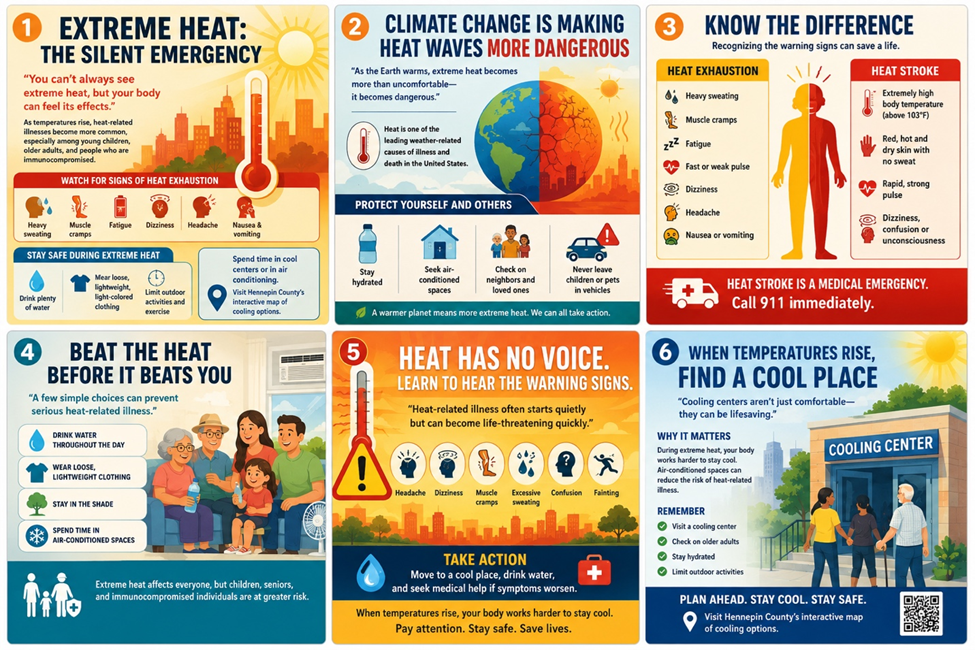
The English, Spanish, and Hmong versions all lean on the same design choice: on-screen text and visual cues carry the safety messages throughout, so the videos work for viewers with limited English proficiency, people watching without sound, and multilingual families where generations may not share a first language. Each video closes with the same core reminders-stay hydrated, limit outdoor activity during peak heat, dress lightly, recognize the symptoms of heat exhaustion and heat stroke, and check on vulnerable family members and neighbors.
The campaign also formalizes something that already happens informally in immigrant and refugee households: younger family members are recruited as community health ambassadors, asked to check that parents, grandparents, and neighbors have water, working cooling access, and transportation if they need to reach somewhere cooler. That intergenerational safety net is a design principle worth carrying directly into CWT’s own outreach, given the multicultural, multigenerational populations the coalition already serves.
Why Heat Is a Wellness Issue, Not Just a Weather Issue
Extreme heat is a direct physiological stressor, and its risks concentrate in the same populations CWT already prioritizes:
- Cardiovascular strain: The body diverts blood flow to the skin to cool itself, raising heart rate and placing added load on anyone managing existing heart conditions.
- Dehydration risk in older adults: A blunted thirst response means significant dehydration can set in before a person feels thirsty at all.
- Heat exhaustion vs. heat stroke: The line between the two is the line between recoverable at home and a medical emergency, which is why symptom recognition-not just prevention tips-is central to the messaging.
- Compounding chronic conditions: Diabetes, respiratory disease, and certain medications used for mental health conditions can all impair the body’s ability to regulate temperature, raising risk for populations already navigating cancer recovery or short-term rehab.
- Uneven exposure: Outdoor workers and residents without reliable cooling access carry a disproportionate share of the risk, which is why cooling-center access and transportation support are built directly into the campaign’s messaging.
The throughline is trust. Public health guidance only works if the messenger feels familiar and the format respects how the audience actually communicates-the same principle behind CWT’s validate-first, no-shame approach to community health outreach around cancer screening. Heat safety and cancer screening look like different topics, but they run on the same trust infrastructure.
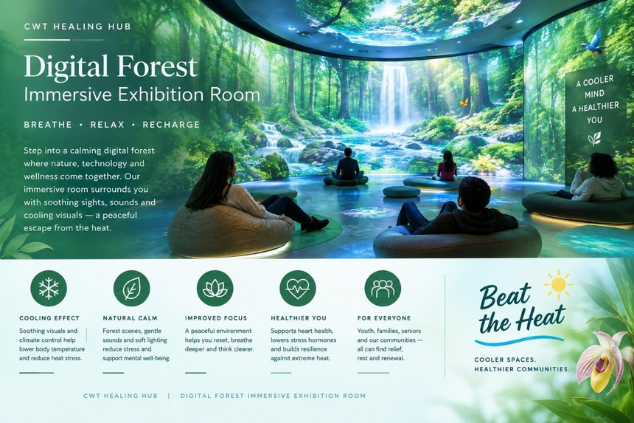
What This Means for the Center for Wellness Technology
CWT sits at the center of a three-node model with M Health Fairview Hospital and a Safer Recovery Center – serving post-hospital patients, adults in short-term rehab, seniors – the exact risk profile that extreme heat threatens most. A few direct applications follow from AMA’s approach:
- Multilingual, multicultural messaging as infrastructure, not an add-on: The St. Paul Wellness Coalition’s African American, Pan-African, and Pan-Asian leadership base gives CWT the same kind of trusted-messenger network AMA relied on through Oromo Diaspora Media, Somali TV, and the Islamic Civic Society of America. Extreme heat guidance-and future seasonal health campaigns-could route through those same community partners rather than being translated after the fact.
- The skyway system as a cooling network: St. Paul’s downtown skyway already connects CWT, area apartments, and other district nodes. Framed explicitly as climate-adaptive infrastructure, the skyway could double as a mapped cooling route for older adults and caregivers moving between appointments during extreme heat days – a concrete, low-cost extension of the ‘activate existing infrastructure’ philosophy already guiding the district.
- Intergenerational health ambassadors: The CWT already connecting Saint Paul Public Schools through local colleges and universities is a natural home for a youth health-ambassador model, training students to check on family and neighbors during heat events while building toward CWT’s broader workforce pipeline.
- Point-of-care wellness as heat-risk screening: CWT’s herbal medicine, acupuncture, and point-of-care wellness offerings put staff in regular contact with older adults and chronically ill patients-natural checkpoints for heat-risk screening and cooling-resource referrals during Minnesota’s hottest months.
As climate patterns continue pushing more extreme heat days into Minnesota summers, culturally responsive public education isn’t a nice-to-have add-on to wellness programming-it’s core infrastructure. AMA’s Beat the Heat campaign demonstrates what that looks like in practice: trusted partnerships, community-tested formats, and messaging designed around how people actually live and communicate. For CWT and the broader St. Paul Wellness Coalition, the opportunity is to fold that same model directly into the City of Wellness vision-using the multicultural coalition already in place, the physical infrastructure already connecting the district, and the trust already built with the communities it serves.
A Practical Starting Point
None of this requires new construction or a new funding vehicle to get moving. AMA’s model shows that the highest-leverage first step is almost always the same: bring the trusted community messengers into the room before a single piece of content gets made, not after. For CWT, that could mean a short pilot-a heat-season adaptation of the existing cancer screening outreach materials, co-developed with FRBCA and MCCA partner organizations, tested with the same kind of small focus groups AMA used, and distributed through the community channels already established for other health messaging.
A pilot like this would also generate something CWT needs regardless of the topic: a reusable production and testing process for culturally specific health communication. Once a community-vetted format exists – animated, plain-language, visually anchored, tested for pacing and tone – it can be adapted for the next seasonal health risk, the next screening campaign, or the next workforce announcement, rather than being rebuilt from scratch each time.
There is also a sequencing advantage to starting with heat safety specifically. It is a lower-stakes, broadly relatable entry point compared to cancer screening or other sensitive clinical topics, which makes it a good testing ground for message format and community trust-building before applying the same process to more difficult conversations. A community that has already seen CWT show up with useful, non-judgmental, in-language guidance about staying safe in the heat is a community more likely to trust CWT’s voice when the topic turns to something like cancer screening or chronic disease management.
The larger point is one of positioning. St. Paul’s bid to become a national model City of Wellness rests on demonstrating that integrated, precision wellness can work at
the population level, not just the individual level. Extreme heat is exactly the kind of population-level, climate-driven health threat that a City of Wellness should be visibly prepared for – and AMA’s Beat the Heat campaign offers a tested, low-cost template for getting there.
Source: Adapted from “Beat the Heat: Multilingual Videos Help Communities Stay Safe During Minnesota’s Extreme Heat,” Asian Media Access, July 29, 2026 – https://www.youtube.com/watch?v=FRVdfr09xkc