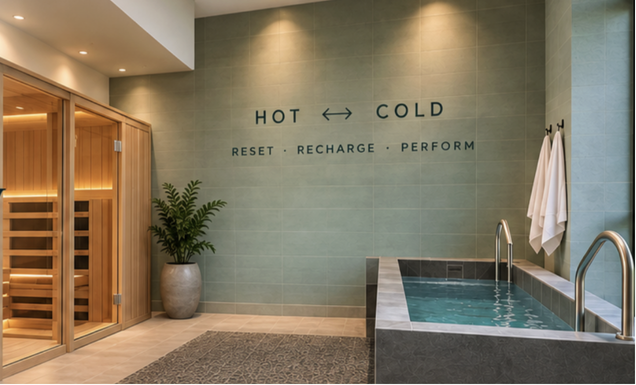
Hot-cold cycling has moved from Nordic bathhouses to mainstream wellness – and a growing body of research is starting to explain why it works.
What Is Contrast Hydrotherapy?
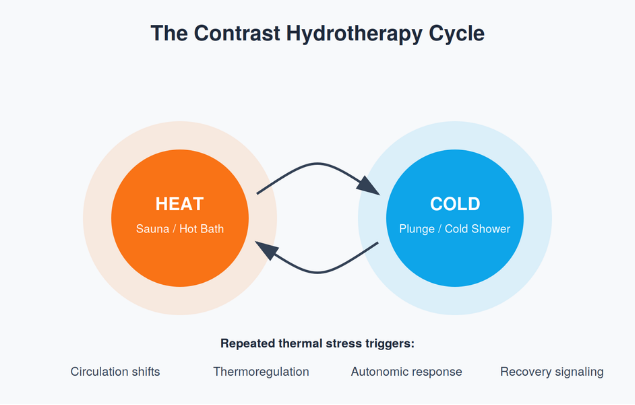
Contrast hydrotherapy is a hydrothermal practice built on alternating heat and cold exposure to trigger repeated physiological stress responses in the body. In practice, it takes many forms: moving between a sauna and a cold plunge, hot and cold baths, steam rooms paired with cold showers, or other structured heating-and-cooling cycles. The practice has deep roots in Nordic, Japanese, Russian, and Central European bathing traditions, where it has long been used to support circulation, recovery, and general wellbeing.
Physiologically, the appeal comes from what happens when the body swings between thermal extremes: circulation shifts, thermoregulatory systems activate, and the autonomic nervous system responds. Most of the existing scientific literature has centered on athletic recovery, but researchers are increasingly turning their attention to broader outcomes – cardiovascular function, stress regulation, and overall wellness – making this a rapidly evolving area of study rather than a settled one.
That momentum is showing up outside the lab too. Saunas and cold plunges have become some of the most visible additions to wellness facilities in recent years, and contrast hydrotherapy – combining the two into a single protocol – represents a natural next step for programs looking to build on that popularity with an evidence-informed offering.
Cardiovascular Effects: New Evidence from Sauna-Cold Water Protocols
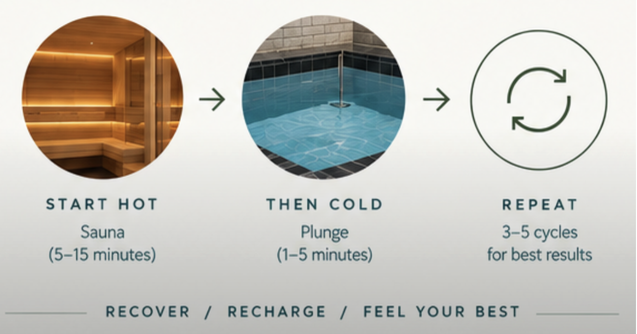
Two 2025 studies add to the picture of how contrast exposure affects the cardiovascular system. Researchers at Poland’s Wroclaw University of Health and Sport Sciences studied 28 healthy, normotensive women who completed three cycles of Finnish sauna heat followed by cold-water immersion. The team found significant changes in cardiovascular measures, including blood pressure and heart rate, indicating that alternating heat and cold produces substantial physiological responses and may help the body adapt to thermal stress. The study did not track long-term health outcomes, but it strengthens the case that sauna-cold immersion protocols common in thermal wellness settings have measurable, real-time effects on cardiovascular regulation.
A separate 2025 study from the Western Norway University of Applied Sciences, conducted through its REACT project, looked at how a single combined session of sauna bathing and cold-water immersion affects the body’s cardiovascular response to physical stress. The researchers pointed out that sauna and cold exposure are usually studied in isolation, even though they are typically practiced together in real-world bathing traditions. Their key finding was notable: a single combined session amplified the blood pressure response to exercise, but not to cold exposure itself – a distinction that hadn’t previously been isolated in the research. While described as preliminary, the study marks a meaningful step toward understanding how contrast therapy actually behaves in the real-world settings – spas, bathhouses, thermal facilities – where it is most commonly practiced, rather than in a controlled athletic-testing environment.
Effects on the Autonomic Nervous System
A 2024 experimental study from the Japan Health and Research Institute examined how both water-based contrast bathing and sauna-based contrast exposure influence the autonomic nervous system, typically assessed through heart rate variability and related markers. The goal was to determine whether alternating heat and cold could meaningfully shift autonomic balance – the push and pull between the body’s stress response and its rest-and-recovery response. The researchers confirmed that contrast interventions do produce measurable autonomic changes, but the effects varied depending on the specific protocol used – bath versus sauna – and were not clearly tied to downstream performance or health outcomes.
Small sample sizes, short-term measurement windows, and a lack of clinical endpoints mean the findings are best understood as mechanistic evidence rather than proof of lasting benefit. In other words, the study confirms that something measurable is happening in the nervous system during contrast exposure, but it stops short of showing that this translates into durable stress-resilience or health gains over time.
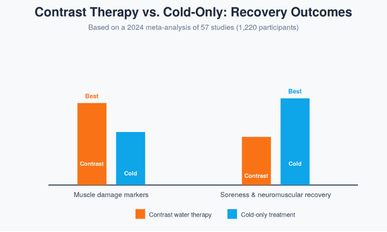
Recovery After Exercise: Contrast Therapy vs. Cold Alone
A larger 2024 meta-analysis from Beijing Sport University pooled results from 57 studies and 1,220 participants to compare water- and temperature-based recovery methods following exercise-induced muscle damage. The analysis found that contrast water therapy – alternating hot and cold – was the most effective approach for reducing biochemical markers of muscle damage, such as creatine kinase. Cold-only treatments, on the other hand, performed best for reducing perceived muscle soreness and improving neuromuscular recovery.
The takeaway is that these two approaches aren’t interchangeable: contrast therapy appears better suited to addressing underlying physiological damage markers, while straight cold exposure has an edge for pain relief and functional recovery. Given the size of this analysis relative to the smaller individual studies above, it offers some of the more robust evidence in this collection – though it, too, is centered on athletic and exercise recovery rather than general wellness populations. Wellness and recovery programs may benefit from treating hot-cold contrast and cold-only protocols as complementary tools suited to different goals, rather than as substitutes for one another.
A Look at Metabolic Health: Early Evidence from Animal Research
A 2016 study published in Nature offers an early, if indirect, look at contrast therapy’s potential metabolic benefits – though it was conducted in mice rather than humans. Researchers found that exposure to mild cold combined with thermogenic compounds called capsinoids reduced diet-induced weight gain by roughly 31%, a substantially larger effect than either intervention produced on its own. The combined exposure was linked to activation of brown and beige fat (the body’s thermogenic fat stores), along with improved insulin sensitivity and glucose metabolism.
The findings suggest thermal stress, particularly cold, can boost energy expenditure through thermogenesis, with potential relevance to obesity treatment. Because this research was conducted in an animal model nearly a decade ago, it should be read as a hypothesis-generating signal rather than a claim about human outcomes – but it helps explain why cold and contrast exposure have drawn interest from a metabolic-health angle, in addition to their cardiovascular and recovery effects, and it points to a clear direction for future human trials.
Where the Research Stands
Taken together, these studies point to a consistent theme: contrast hydrotherapy produces real, measurable physiological effects – on blood pressure and heart rate, on autonomic nervous system activity, on biochemical markers of muscle recovery, and potentially on metabolic regulation. What the research does not yet offer is a clear, unified picture of long-term health outcomes. Sample sizes remain small, protocols vary widely between studies, and much of the strongest evidence still centers on athletic recovery rather than general wellness populations.
That gap is exactly where the field is heading next. As sauna use and cold plunging continue to grow as mainstream wellness practices, researchers are increasingly asking how these protocols perform outside the athletic training context – in everyday cardiovascular health, stress management, and metabolic wellness. For wellness programs and practitioners, the current evidence offers a reasonable foundation to build on: enough consistent, measurable physiological effect across independent research groups to justify offering contrast hydrotherapy as a modality, paired with the honest caveat that much of it remains mechanistic and preliminary rather than definitive proof of long-term benefit.
For the Center for Wellness Technology considering contrast hydrotherapy as part of a broader wellness or recovery offering, the practical implication is straightforward: it is well supported as a modality with real, trackable physiological effects, best positioned alongside – not in place of – other recovery and stress-management tools, and worth continuing to monitor as more human-outcome research becomes available.
Sources: Studies referenced above were drawn from Nature, the journal Physiology (Western Norway University of Applied Sciences / REACT project), the Journal of Physiological Anthropology (J-STAGE), and PubMed. Full research on contrast hydrotherapy can be explored through PubMed, Trip, Cochrane, and Semantic Scholar databases.