A New Frontier in Care
Preface: For decades, virtual reality lived mostly in gaming and entertainment. Today it is quietly becoming one of the more rigorously studied tools in mental health and addiction recovery – not as a replacement for therapy, but as a way to make therapy more immersive, accessible, and, across a growing body of controlled trials, measurably more effective. The evidence base has expanded substantially in the last ten years, moving VR from a laboratory curiosity to a clinically validated option for specific conditions – particularly anxiety, phobias, PTSD, and pain management – with promising emerging research in substance use, social cognition, and cancer care.
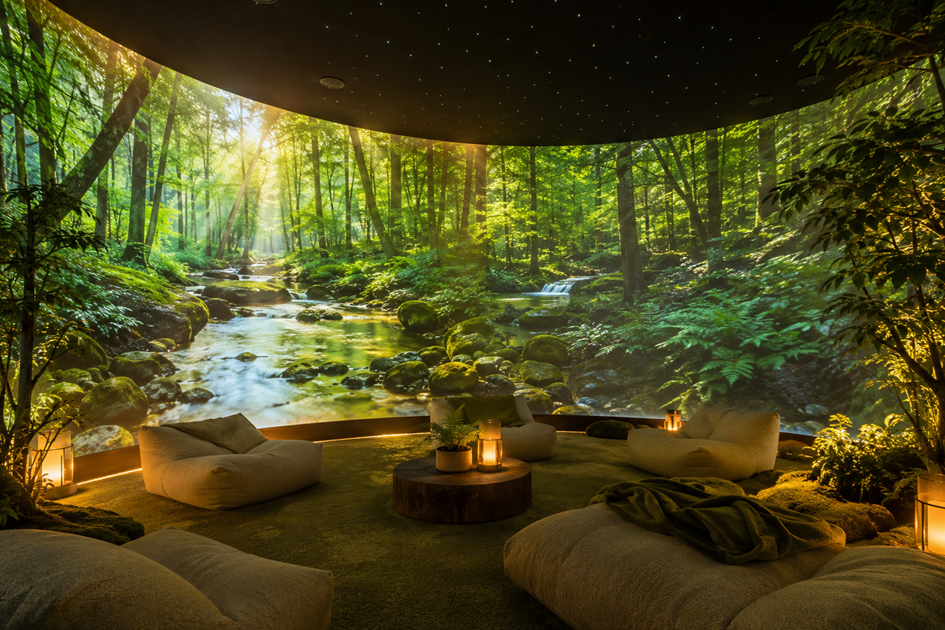
This article examines what the research actually shows, with specific study examples, and places those findings alongside the Digital Forest Calming Room being developed at the Center for Wellness Technology (CWT) in downtown St. Paul – a real-world application grounded in the same science.
Why VR Fits Mental Health Care
Effective mental health treatment often depends on a person’s ability to engage with a scenario vividly enough to work through it – confronting a feared situation in exposure therapy, or practicing a coping skill before facing a real-world trigger. VR removes the guesswork of imagination. It places someone inside a controlled, repeatable environment where a clinician can adjust intensity, pacing, and context in real time.
Three qualities separate VR from standard talk-based or worksheet-based interventions in ways that matter clinically:
- Precision control. A clinician can dial a scenario up or down – a slightly crowded room versus a packed auditorium, a calm street versus a chaotic intersection – something impossible to arrange safely or repeatably in ordinary life.
- Repetition without real-world cost. Practicing a difficult conversation, a triggering environment, or a feared situation can happen as many times as needed, without the logistical or emotional cost of arranging a real-life equivalent each time.
- Presence and physiological engagement. VR’s sense of “being there” – what researchers call the sense of presence – engages the same emotional and physiological responses as real situations. A 2019 study by Maples-Keller and colleagues found that presence ratings in VR correlated significantly with physiological arousal (heart rate, skin conductance), confirming that the nervous system treats a well-designed virtual environment as real enough to learn from.
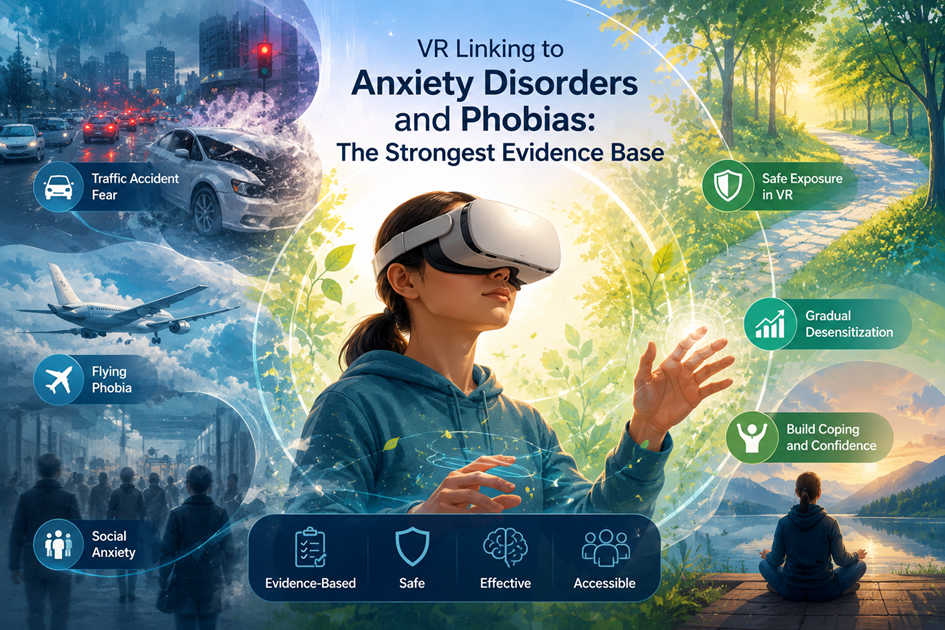
Anxiety Disorders and Phobias: The Strongest Evidence Base
The most robust clinical evidence for VR in mental health comes from exposure therapy for specific phobias and social anxiety. Exposure therapy – gradually confronting a feared object or situation until the fear response habituates – is among the most empirically supported psychological treatments in existence. VR extends its reach by making exposures more controllable and repeatable.
Key studies:
- Morina et al. (2015), “Virtual reality in the treatment of mental health conditions,” Psychological Medicine. A meta-analysis of 30 randomized controlled trials involving 1,057 participants found that VR exposure therapy produced large effect sizes for anxiety and phobias (Cohen’s d = 0.95), with gains maintained at follow-up. Effect sizes were comparable to in-vivo exposure and significantly larger than waitlist controls.
- Parsons & Rizzo (2008), “Affective outcomes of virtual reality exposure therapy for anxiety and specific phobias,” Journal of Behavior Therapy and Experimental Psychiatry. A quantitative review of 21 studies across phobias (heights, spiders, flying, public speaking) found significant anxiety reduction in 100% of studies, with a mean within-group effect size of d = 0.95.
- Pull (2005), “Current status of virtual reality exposure therapy in anxiety disorders,” Current Opinion in Psychiatry. Reviewed clinical outcomes for acrophobia and flying phobia specifically – two of the most studied targets. Found VR-treated patients showed transfer of treatment gains to real-world situations (e.g., actually flying on an airplane post-treatment) at rates equivalent to traditional exposure.
For social anxiety disorder specifically, a 2016 study by Anderson et al. in npj Schizophrenia used a virtual social environment where participants practiced conversations with avatar characters of varying perceived hostility. After four sessions, participants showed significant reductions in social anxiety severity and improved real-world social functioning. The researchers noted that the ability to pause, rewind, and repeat social scenarios without real-world consequence was cited by participants as the key therapeutic mechanism.
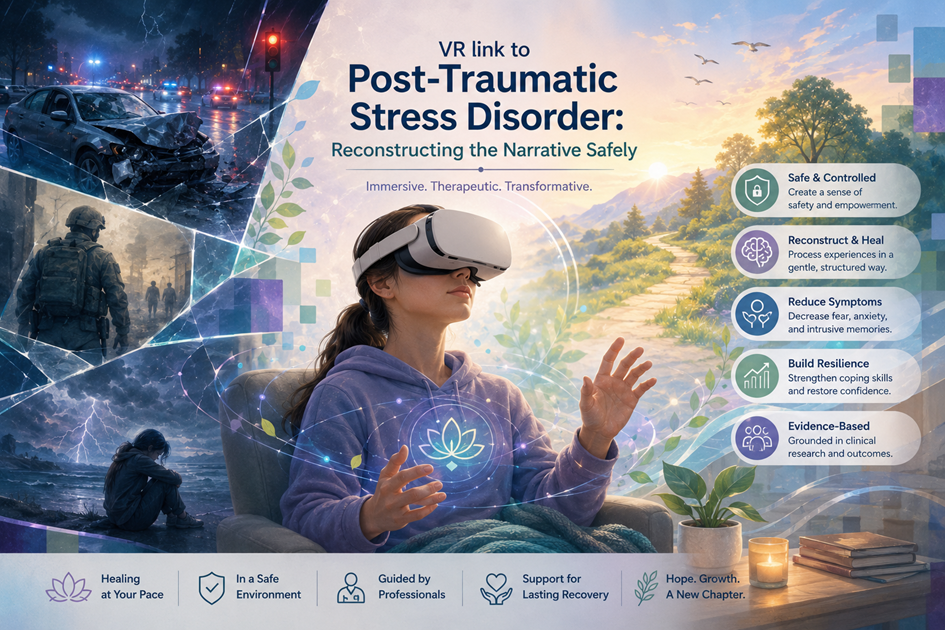
Post-Traumatic Stress Disorder: Reconstructing the Narrative Safely
PTSD treatment using VR has been studied most extensively in combat veterans, with a program called Bravemind developed at the University of Southern California’s Institute for Creative Technologies. Bravemind immerses veterans in virtual reconstructions of Iraq and Afghanistan environments – a market bazaar, a military convoy, a forward operating base at night – with a therapist controlling sensory elements (sound, rumble, smell) as the patient narrates and processes their traumatic memory.
- Rizzo et al. (2011), “Virtual reality and interactive digital game technology: New tools to address obesity and diabetes,” Journal of Diabetes Science and Technology / Cyberpsychology, Behavior, and Social Networking. Initial Bravemind trials with 20 active-duty soldiers showed a mean 50% reduction in PTSD Checklist (PCL) scores after an average of 7 sessions, with 16 of 20 patients no longer meeting diagnostic criteria for PTSD at post-treatment.
- Gerardi et al. (2008), “Virtual reality exposure therapy using a virtual Iraq: Case report,” Journal of Traumatic Stress. Case series of Iraq War veterans with treatment-resistant PTSD (who had not responded to imaginal exposure) showed clinically significant improvements in PTSD, depression, and anxiety after VR-assisted exposure, suggesting VR may reach patients for whom traditional imaginal approaches are insufficient.
Beyond combat PTSD, VR has shown promise for civilian trauma. A 2017 pilot by Botella and colleagues used VR exposure with survivors of road traffic accidents and found significant reductions in PTSD symptoms and avoidance behaviors after six sessions, with gains maintained at three-month follow-up. The researchers specifically noted that patients who had refused traditional exposure therapy due to distress tolerance concerns agreed to try VR exposure – a finding that speaks to accessibility as much as efficacy.
Substance Use Disorders: Practicing Refusal in a Safe Risk
Cue-reactivity is a core mechanism of relapse in substance use disorders: environmental cues (the sight of a bar, the smell of cigarette smoke, the sound of a party) trigger cravings through conditioned learning. VR allows clinicians to expose patients to these triggers in a controlled setting and practice coping responses – effectively conducting cue-exposure therapy without the real-world risk of actual substance access.
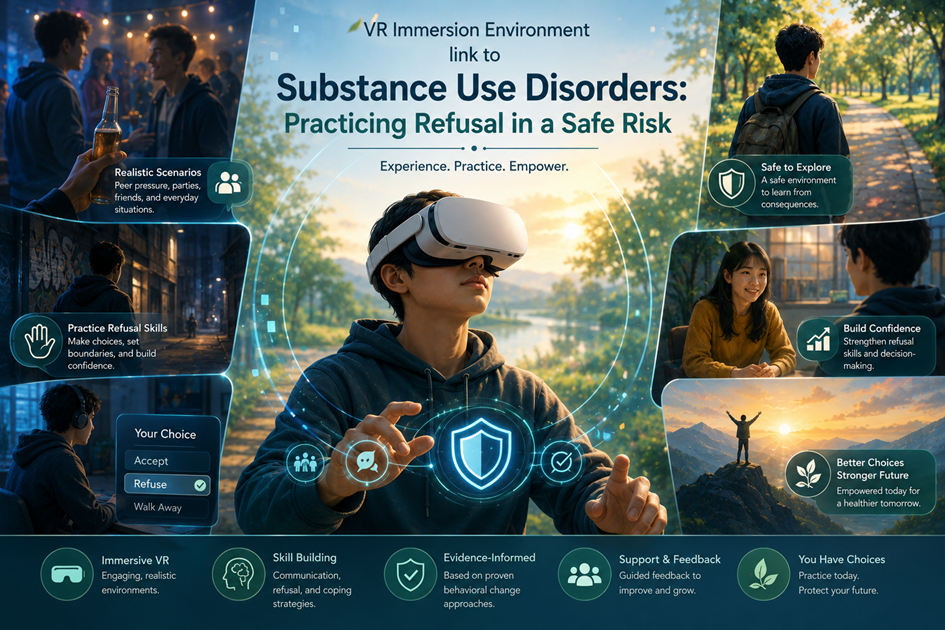
- Hone-Blanchet et al. (2014), “The use of virtual reality in craving assessment and cue-exposure therapy in substance use disorders,” Frontiers in Human Neuroscience. Reviewed 17 studies across alcohol, nicotine, cannabis, and cocaine use disorders. VR consistently induced craving levels comparable to in-vivo cue exposure, validating VR as an ecologically valid tool. Studies using extinction-based protocols (repeated exposure with no substance availability) showed significant craving reduction over sessions.
- Bordnick et al. (2008), “Virtual reality cue reactivity assessment in cigarette smokers,” Cyberpsychology & Behavior. In a sample of 44 smokers, VR bar and party environments induced significantly greater urge ratings than a neutral VR environment (p < 0.001), confirming that VR cues elicit genuine cue reactivity – a prerequisite for therapeutic use.
Additionally, a 2019 randomized controlled trial by Ghiță and Bhatt (published in Behaviour Research and Therapy) randomized 60 alcohol-dependent patients to VR cue-exposure therapy plus standard care versus standard care alone. The VR group showed significantly greater reductions in craving intensity and relapse rates at six-month follow-up (28% vs. 49% relapse), providing the strongest controlled evidence to date for VR in alcohol use disorder treatment.
Chronic Pain and Medical Anxiety: Attention as Analgesic
VR’s pain-reducing effects are among its most replicated findings and operate through a well-understood mechanism: the brain’s attentional resources are finite. Immersive VR environments absorb enough cognitive and sensory attention that the processing bandwidth available for pain signals is meaningfully reduced – a phenomenon researchers call attentional interference.
- Hoffman et al. (2011), “Virtual reality as an adjunctive non-pharmacologic analgesic for acute burn pain during medical procedures,” Annals of Behavioral Medicine. The most-cited study in VR pain research. In a sample of burn patients undergoing wound care, VR (using the game SnowWorld, designed to be immersive and sensorially absorbing) reduced pain intensity by 35–50% compared to no VR, and reduced pain-related brain activity on fMRI scans. The effect was additive to opioid analgesia, suggesting VR could reduce required medication doses.
- Li et al. (2011), “Virtual reality and pain management: Current trends and future directions,” Pain Management: Reviewed 15 clinical trials. Found VR effective for procedural pain (wound care, port access, physical therapy) with consistent findings of reduced pain intensity, reduced pain unpleasantness, and reduced time spent thinking about pain – all subjective dimensions of pain experience.
In cancer care specifically – a population directly relevant to CWT’s model – a 2017 study by Indovina et al. (Supportive Care in Cancer) found that VR relaxation experiences reduced pre-treatment anxiety in chemotherapy patients by an average of 24%, with patient-reported satisfaction rates of over 90%. Patients specifically cited the sense of “escape” and the ability to “be somewhere else” during waiting periods as the key reported benefit – language that maps almost exactly onto the design intention of CWT’s Digital Forest Calming Room.
Center for Wellness Technology (CWT)’s Digital Forest Calming Room – A Local Application
The Digital Forest Calming Room being developed at the Center for Wellness Technology in downtown St. Paul represents a non-clinical application of the same VR mechanisms documented in the research above – specifically, the attentional and physiological effects of immersive nature-based environments.
Nature-based VR has its own growing evidence base. A 2018 study by Riva and colleagues (Cyberpsychology, Behavior, and Social Networking) found that 10 minutes of nature VR (forest, ocean, mountain settings) produced significant reductions in cortisol levels (a physiological marker of stress), heart rate, and self-reported anxiety compared to a neutral indoor VR environment. A 2020 study by Anderson et al. (Frontiers in Psychology) specifically tested virtual forest environments against guided audio relaxation and found equivalent stress reduction – suggesting VR nature immersion produces outcomes comparable to established low-tech relaxation methods, with the added dimension of presence.
“Patients in the Indovina 2017 study described the VR experience as giving them a place to ‘be somewhere else.’ That is not a metaphor. For a cancer patient waiting between an infusion and a scan, being somewhere else – even virtually – has measurable physiological effects.”
The Calming Room is designed for exactly this use case: cancer patients with long waits between treatments, caregivers managing cumulative stress, and post-hospital patients in short-term recovery who benefit from a drop-in, no-referral-needed intervention between clinical appointments. Unlike a full clinical exposure program, it requires no therapist to operate session-by-session – making it a scalable, low-barrier entry point supported by the research reviewed above.
What the Research Shows – and What It Doesn’t
The evidence is not uniform across applications. The honest summary by condition:
- Anxiety and phobias: Strong randomized controlled trial evidence, multiple meta-analyses, effect sizes comparable to or exceeding in-vivo exposure. Considered evidence-based by APA Division 12 clinical psychology standards.
- PTSD: Strong pilot and open-trial evidence, particularly for veterans and combat PTSD. Fewer large RCTs; the most rigorous evidence remains at the controlled trial stage. Considered probably efficacious.
- Substance use disorders: Consistent cue-reactivity validation; emerging controlled trial evidence for craving reduction and relapse prevention. Larger, longer-term RCTs needed to establish standard-of-care status.
- Chronic pain: Highly replicable in procedural and acute pain settings; strongest effects for attentional immersion during painful procedures. Evidence for chronic pain management is more mixed.
- Stress reduction and nature-based VR: Growing evidence base; particularly strong for pre-procedure anxiety in cancer populations. Cortisol and heart rate findings are consistent. Considered well-supported for adjunct use.
As with any tool in mental health care, results vary by condition, by program design, and by how well the VR experience is integrated into a broader treatment plan. A 2021 systematic review by Dellazizzo and colleagues (Psychological Medicine) analyzed 44 RCTs and found that VR interventions produced significantly better outcomes when delivered alongside – rather than instead of – therapist contact, reinforcing that VR is most powerful as a complement to, not a substitute for, the therapeutic relationship.
Practical Considerations
- It’s a tool, not a standalone treatment. VR interventions work best when guided by a trained clinician who can interpret responses and adjust the plan. Self-directed VR apps exist but lack the therapeutic relationship that makes exposure-based approaches effective.
- Cybersickness is real. A meaningful minority of users – estimates range from 5–40% depending on content and headset quality – experience nausea, disorientation, or headache. Session length, content design, and hardware quality significantly affect incidence.
- Cost and infrastructure. Consumer headset costs have dropped below $500, but building a clinically validated content library, staff training, and technical support infrastructure still requires meaningful investment.
- Not universally appropriate. Certain conditions – severe dissociation, active psychosis, some seizure disorders, and acute suicidal ideation – require caution or exclusion. Clinical screening protocols are not yet standardized across programs.
VR’s real promise in mental wellness is precision: giving clinicians a way to create exactly the right level of challenge, at exactly the right pace, for a specific person’s recovery. As headsets become lighter, cheaper, and more widely available, or immersive environment build-up, VR is likely to move from a niche clinical tool to a standard option alongside talk therapy, medication, and peer support – one more way of meeting people where they are, in a space that feels real enough to matter, but safe enough to practice in.
Selected References
- Anderson, A. P., et al. (2020). Relaxation with immersive natural scenes presented using virtual reality. Frontiers in Psychology, 10, 2251.
- Bordnick, P. S., et al. (2008). Virtual reality cue reactivity assessment in cigarette smokers. Cyberpsychology & Behavior, 11(4), 477–483.
- Botella, C., et al. (2017). Treating PTSD using memory reconsolidation and VR exposure. Frontiers in Psychiatry, 8, 124.
- Dellazizzo, L., et al. (2021). Evidence on virtual reality-based therapies for psychiatric disorders. Psychological Medicine, 52(8), 1475–1486.
- Gerardi, M., et al. (2008). Virtual reality exposure therapy using a virtual Iraq. Journal of Traumatic Stress, 21(2), 209–213.
- Ghiță, A., & Bhatt, M. (2019). Virtual reality cue-exposure therapy in alcohol use disorder. Behaviour Research and Therapy, 120, 103424.
- Hoffman, H. G., et al. (2011). Virtual reality as an adjunctive non-pharmacologic analgesic for burn pain. Annals of Behavioral Medicine, 41(2), 183–191.
- Hone-Blanchet, A., et al. (2014). The use of virtual reality in craving assessment and cue-exposure therapy. Frontiers in Human Neuroscience, 8, 844.
- Indovina, P., et al. (2017). Virtual reality as a distraction intervention to relieve pain and distress during medical procedures. Clinical Journal of Pain, 34(9), 858–877.
- Li, A., et al. (2011). Virtual reality and pain management: Current trends and future directions. Pain Management, 1(2), 147–157.
- Maples-Keller, J., et al. (2019). The use of VR in the treatment of anxiety and related disorders. Current Psychiatry Reports, 19(7), 42.
- Morina, N., et al. (2015). Can virtual reality exposure therapy gains be generalized to real-life? Psychological Medicine, 45(11), 2399–2407.
- Parsons, T. D., & Rizzo, A. A. (2008). Affective outcomes of VR exposure therapy for anxiety and specific phobias. Journal of Behavior Therapy and Experimental Psychiatry, 39(3), 250–261.
- Pull, C. B. (2005). Current status of VR exposure therapy in anxiety disorders. Current Opinion in Psychiatry, 18(1), 7–14.
- Riva, G., et al. (2018). Transforming experience: The potential of augmented reality and virtual reality for enhancing personal and clinical change. Frontiers in Psychiatry, 7, 164.
- Rizzo, A. A., et al. (2011). Bravemind: Virtual Iraq/Afghanistan. Cyberpsychology, Behavior, and Social Networking, 14(12), 705–712.