Columnist – Vivek Ekarat
The World Economic Forum unveils a groundbreaking framework that could reshape how we teach students to thrive in an AI-dominated world
The Question That Defines Our Era
How do we prepare students for a future shaped by artificial intelligence—when the future is already here? This isn’t a philosophical exercise or a distant planning challenge. It’s the most urgent educational imperative of our time, and it’s happening in classrooms around the world right now.
While teachers explain fractions and literary themes, their students are quietly using ChatGPT to write essays, asking AI to solve math problems, and experimenting with image generators for art projects. The technology that will define their careers and lives isn’t waiting for educational systems to catch up—it’s already in their pockets, reshaping how they think, learn, and create.
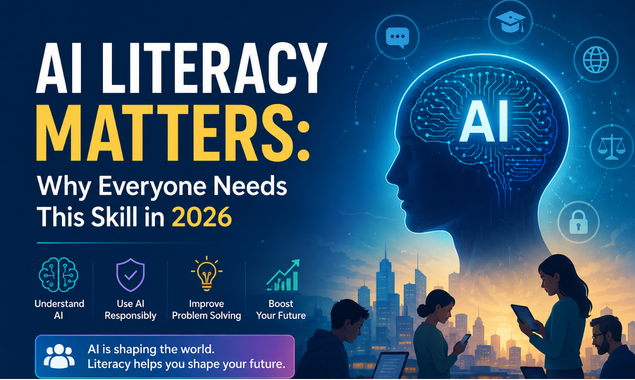
This reality has prompted the World Economic Forum’s Tanya Milberg to sound an alarm that educators worldwide are beginning to hear: artificial intelligence literacy must become a core educational competency, not just an optional upgrade for tech-savvy schools or computer science classes.
Enter the AI Literacy Framework: A Global Response
The urgency of this challenge has sparked an unprecedented collaboration between some of the world’s most influential educational organizations. The European Commission, OECD, Code.org, and a coalition of global experts have joined forces to create the AI Literacy Framework (AILit)—a comprehensive roadmap designed to equip learners with the knowledge, skills, and mindsets they need to engage with AI critically, ethically, and creatively across all disciplines.
This isn’t just another educational initiative. It represents a fundamental reimagining of what literacy means in the 21st century and how we can prepare students not just to use AI tools, but to understand their implications, limitations, and potential for both good and harm.

The Challenge: When Technology Outpaces Education
The Speed of Change
The pace of AI development has created an unprecedented challenge for educational systems. While traditional curricula take years to develop and implement, AI capabilities are evolving monthly. GPT-4 was revolutionary in March 2023; by 2024, it seemed almost quaint compared to newer models. Students are growing up with technology that’s advancing faster than the institutions designed to guide them.
The Digital Divide Gets Deeper
This rapid evolution isn’t just creating a gap between technology and education—it’s creating new forms of inequality. Students with access to the latest AI tools and informal learning opportunities are developing capabilities that traditional assessments can’t measure, while others are being left behind by systems that haven’t yet acknowledged AI’s educational relevance.
The Trust Crisis
Perhaps most concerning is the growing disconnect between what students experience with AI and what educators can confidently teach about it. Many teachers feel unprepared to address AI’s educational implications, leading to policies that range from complete bans to unrestricted access—neither of which prepares students for the nuanced reality of living and working with AI.
The AILit Framework: A Comprehensive Solution
Four Pillars of AI Literacy
The framework organizes AI literacy around four fundamental areas that students need to master:
1. Engaging with AI Understanding how AI systems work, their capabilities and limitations, and how to interact with them effectively. This includes developing critical evaluation skills to assess AI-generated content and understanding when AI is and isn’t appropriate for different tasks.
2. Creating with AI Learning to use AI as a creative and productive tool while maintaining human agency and creativity. This involves understanding how to prompt AI systems effectively, how to combine AI capabilities with human insight, and how to maintain ethical standards in AI-assisted creation.
3. Managing AI Developing the skills to oversee AI systems responsibly, including understanding privacy implications, managing data, and making decisions about when and how to deploy AI tools in different contexts.
4. Designing AI Building foundational understanding of how AI systems are created, trained, and implemented. While not every student will become an AI developer, understanding these processes is crucial for informed citizenship in an AI-driven world.
23 Competencies for the AI Age
Within these four pillars, the framework identifies 23 specific competencies that students should develop. These aren’t abstract concepts but practical skills that can be adapted across subjects and grade levels:
Critical Thinking Competencies
- Evaluating AI-generated information for accuracy and bias
- Understanding the difference between AI predictions and facts
- Recognizing when human judgment is necessary
Ethical Reasoning Skills
- Considering the societal implications of AI decisions
- Understanding issues of fairness and representation in AI systems
- Developing frameworks for responsible AI use
Creative Collaboration Abilities
- Working effectively with AI as a creative partner
- Maintaining human creativity while leveraging AI capabilities
- Understanding the value of human insight in AI-assisted processes
Technical Understanding
- Grasping fundamental concepts of how AI learns and makes decisions
- Understanding data’s role in AI system performance
- Recognizing the limitations and potential failures of AI systems
Beyond Computer Science: AI Literacy Across the Curriculum
Mathematics and AI
In mathematics classes, students can explore how AI systems use statistical patterns to make predictions, understand the role of probability in machine learning, and use AI tools to visualize complex mathematical concepts while developing critical thinking about algorithmic decision-making.
Language Arts and AI
English and literature classes can examine AI-generated text to understand narrative structure, explore the ethical implications of AI authorship, and develop skills in human-AI collaborative writing while maintaining authentic voice and creative agency.
Social Studies and AI
History and civics education can explore AI’s societal implications, examine algorithmic bias through historical lenses, and help students understand their rights and responsibilities as citizens in increasingly automated societies.
Science and AI
Science classes can use AI to analyze data, model complex systems, and explore scientific questions while developing understanding of how AI can both advance and potentially mislead scientific inquiry.
Arts and AI
Creative arts education can explore AI as both tool and medium, examining questions of authorship and creativity while helping students develop unique artistic voices that incorporate rather than compete with AI capabilities.
Global Alignment and Local Adaptation
Building on Existing Initiatives
The AILit Framework doesn’t exist in isolation. It builds on and aligns with established programs like AI4K12, which has been developing AI education standards for American schools, and DigComp, the European framework for digital competence. This alignment ensures that the framework can integrate with existing educational standards rather than requiring completely new curricula.
Flexibility for Diverse Contexts
One of the framework’s key strengths is its recognition that educational contexts vary dramatically around the world. Schools in different countries, regions, and communities have different resources, priorities, and cultural values. Rather than prescribing a one-size-fits-all approach, the framework provides a flexible foundation that can be adapted to local needs and constraints.
Watch the full article: https://glintops.com/preparing-tomorrows-citizens-the-ai-literacy-revolution-in-education/